F/A-18 Sonic Boom
Updated Mar 16 2008
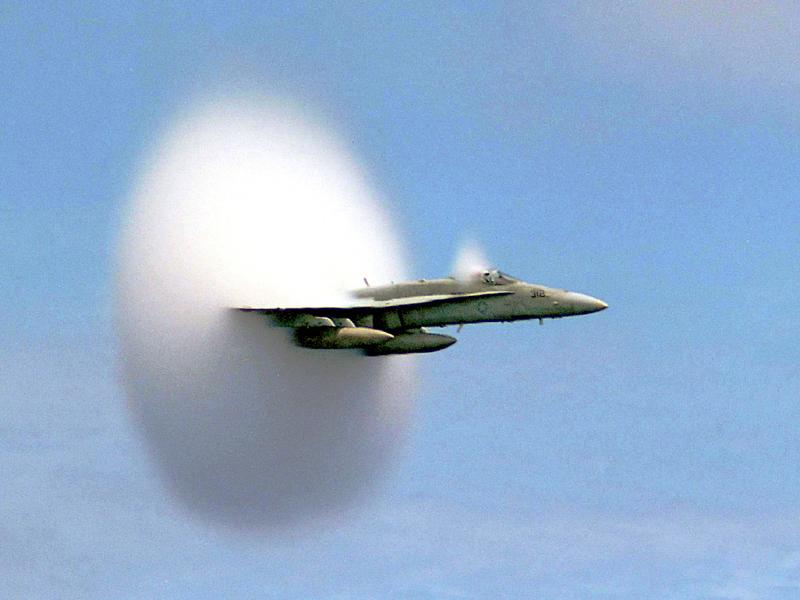
Lieutenant Ron Candiloro, VF-151, USS Constellation (CV-64), July 07 1999, off the coast of Hawaii.
Photographer Ensign John Gay, VF-2, USS Constellation (CV-64). Photo available from USN website. 01/26/2001
Through the viewfinder of his camera, Ensign John Gay could see the fighter plane drop
from the sky heading toward the port side of the aircraft carrier Constellation. At
1,000 feet, the pilot drops the F/A-18C Hornet to increase his speed to 750 mph, vapor
flickering off the curved surfaces of the plane.
In the precise moment a cloud in the shape of a farm-fresh egg forms around the Hornet
200 yards from the carrier, its engines rippling the Pacific Ocean just 75 feet below,
Gay hears an explosion and snaps his camera shutter once.
"I clicked the same time I heard the boom, and I knew I had it", Gay said. What he
had was a technically meticulous depiction of the sound barrier being broken July 7,
1999, somewhere on the Pacific between Hawaii and Japan. Sports Illustrated, Brills
Content, and Life ran the photo.
The photo recently took first prize in the science and technology division in the
World Press Photo 2000 contest, which drew more than 42,000 entries worldwide.
"All of a sudden, in the last few days, I've been getting calls from everywhere about
it again. It's kind of neat," he said, in a telephone interview from his station in
Virginia Beach, VA.
A naval veteran of 12 years, Gay, 38, manages a crew of eight assigned to take
intelligence photographs from the high-tech belly of an F-14 Tomcat, the fastest
fighter in the U.S. Navy. In July, Gay had been part of a Joint Task Force Exercise
as the Constellation made its way to Japan.
Gay selected his Nikon 90 S, one of the five 35 mm cameras he owns. He set his 80-300
mm zoom lens on 300 mm, set his shutter speed at 1/1000 of a second with an aperture
setting of F5.6. "I put it on full manual, focus and exposure," Gay said. "I tell
young photographers who are into automatic everything, you aren't going to get that
shot on auto. The plane is too fast. The camera can't keep up."
At sea level a plane must exceed 741 mph to break the sound barrier, or the speed at
which sound travels. The change in pressure as the plane outruns all of the pressure
and sound waves in front of it is heard on the ground as an explosion or sonic boom.
The pressure change condenses the water in the air as the jet passes these waves.
Altitude, wind speed, humidity, the shape and trajectory of the plane - all of these
affect the breaking of this barrier. The slightest drag or atmospheric pull on the
plane shatters the vapor oval like fireworks as the plane passes through, he said
everything on July 7 was perfect. "You see this vapor flicker around the plane that
gets bigger and bigger. You get this loud boom, and it's instantaneous. The vapor
cloud is there, and then it's not there. It's the coolest thing you have ever seen."
- writer unknown
Related sites: www.rense.com/general8/boom.htm
www.wilk4.com/misc/soundbreak.htm
www.jp-petit.com/nouv_f/B2/B2_7.htm
Thanks to Kathryn for finding this article.
Notes from Q, aeronautical engineer:
A common misconception is that this airplane is actually travelling supersonic. What
we see is a high subsonic airplane with localised supersonic flow. You can see it over
the canopy and a lot of it over the wing. If one is close enough the sonic boom from
this local flow can still be heard though.
Comments from TJ, Northrop-Grumman:
I continue to be frustrated seeing photographs from otherwise intelligent men, that
depict a low pressure area over a wing as "an aircraft breaking the sound barrier".
In almost all of the photographs, the so-called "sound barrier" is, in fact, merely
water vapor flashing from a gaseous to liquid state as the air pressure over the wing
decreases. The process of passing mach 1 is a propagation phenomenon not a visible
phenomenon.
and from Q:
TJ is correct for the most part, but shock waves can be a visible phenomenon as
evidenced from the F-18 and F-4 photos on this page. We see low pressure transonic/
supersonic flow above and below the wing as water vapor, then it disappears suddenly
with a shock wave toward the trailing edge as the air abruptly becomes subsonic. Both
the airplanes are flying subsonic but the flow accelerates over the wing to higher
subsonic then supersonic speeds accompanied by a drop in temperature. The temperature
drop not the associated pressure drop (per TJ) condenses the water. The water suddenly
disappears at the shock wave which takes the flow over the wing back down to the
subsonic speed that the airplane is flying.
In the course of validating the F/A-18 information (because Greg questioned it's
veracity), I came across this picture:
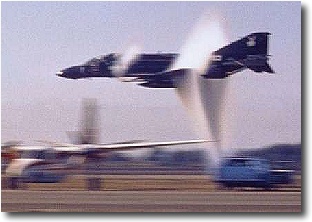
 The picture was taken by Mr. Harry Gann of Mcdonnell-Douglas Aircraft Co 10/23/1971.
The F-4 is from the Navy's Air Test and Evaluation Squadron Four (VX-4) at Point Mugu.
I attended a very foggy Mugu show in the late 80s (87?) with Greg, Ken, Kepford, and
others where the Black Bunny did an extremely high-speed pass. At that time, Ken told
me that the F-4 had broken the sound barrier, and I didn't believe him. d'OH! :o
As I recall, the fog effectively ended the airshow, which is always a chance at Mugu.
But, Vandy-1, VX-4's all-black F-4J with the Playboy Bunny on the tail, took off in
the fog and proceeded to put on a furious demo. During a low altitude, high-speed
pass, the F-4 went transonic, as in the picture.
-- Lonny
Notes from Q, aeronautical engineer:
At the time I thought so too, hearing the boom seemed like pretty good evidence. The
sonic boom we did hear was really the local supersonic flow around the wing, the boom
from this dissipates rapidly with distance, but we were so close and he was pushing
to the limit so that we had an audible disturbance. Supersonic or not, the pass was
awesome, I just wish Greg hadn't been in the port-o-john when it happened.
and notes from...
Subject: Pt. Mugu airshow F-4 -- Supersonic? (the TRUTH)
Date: Tue, 22 Jul 2003 12:50:24 -0700
I happened upon your web page: http://home1.gte.net/lbalders/f18_sb.htm and
found the discussion regarding whether any of the pictured aircraft were
actually supersonic. "Q" and "TJ" are correct that there are often pictures
of fighters pulling G's in a humid environment and the local flow in the low
pressure region above the wing is low enough to cause condensation fog to
appear. That has nothing to do with supersonic.
And yes, those pictures that show condensation just aft of the top of the
canopy and extend nearly perpendicular from the wing ARE locally transonic
flow. Most aerodynamicists say transonic is 0.8-1.2 Mach so that doesn't
answer the question -- is the aircraft supersonic?
Let's take the case of the black F-4 "Vandy 1" at the 1988 Pt. Mugu airshow.
In the age of the F-14 and F-18, there was only so much an F-4 could do to
impress anyone. The pilot in that show normally flew the F/A-18 but he had
about 1000 hours in various models of the Phantom and had flown it at both
the USN Topgun and USMC Weapons and Tactics Instructor schools. He planned
a pretty aggressive airshow that included a low speed pass with everything
hanging in the breeze, followed by a high speed pass at .96-.98 Mach.
During the practice shows he flew at low altitude down the runway in full
afterburner until 0.96 Mach (which he normally reached at the approach end
of the runway). He then would pull the power back slightly to maintain the
speed less than 0.98 Mach. The pilot was trying to achieve a high enough
speed so that small areas of local supersonic flow would occur over the
canopy, inlet RHAW antennas, etc. that would produce a sound similar to the
crack of a supersonic rifle bullet -- not the potentially window shattering
BOOM that would occur if the aircraft itself went faster than 1.0M. After
the F-4 passed show center the pilot would do a vertical pull up followed by
a rudder reversal (a difficult, Vietnam era maneuver that was designed as a
means to separate from a bled down MiG-21, achieve a couple of miles of
nearly instantaneous vertical separation and then quickly swap ends with
enough range to get off an AIM-9 shot).
At most airshows the Blue Angels are the finishing act but at this show, the
F-4 followed the Blues (perhaps so the spectators had something to look at
while they were filing back to their cars). On the day in question the haze
was so bad that the Blues asked the F-4 pilot to fly first and give them a
PIREP. The visibility was very limited horizontally but it was easy to see
the ground from above. When the F-4 extended out for the high speed pass
the pilot was having a difficult time keeping the runway environment in
sight so he asked his RIO to read off his Mach to him.
As he raced inbound the RIO began counting up. It was taking longer than
normal and it wasn't until just prior to show center that the RIO called out
".96". The pilot brought his eyes down to his own Mach meter to begin
regulating the throttle and was shocked to see his Mach needle was quivering
at .9999 Mach! Before he could react the needle jumped past "the number".
He immediately slammed the throttles out of burner and began the 6.5 G
vertical pull. He didn't know whether or not those on the ground thought he
had gone supersonic but he put it out of his mind and concentrated on the
rest of the show.
The moment he taxied clear of the runway after the full-stop, the tower
radioed "NICE BOOM". Oops. It was reported that those that were in the
stands, especially those that were west of show center heard a distinct
sonic boom and erupted in a cheer. It was also reported the FAA rep did not
look very happy but decided to ignore it.
So, the answer to the question is: the F-4 was, in fact, supersonic.
Luckily the pilot had thought enough to plan the maneuver heading out to
sea. The F-14 pilot did the same maneuver heading inland and hit the number
during a practice run. The sonic boom radiated forward and knocked boxes
off the shelves of the Camarillo post office that was five miles directly
ahead.
I should know,
Mark "Forger" Stucky
Vandy 1 airshow pilot - '87 and '88
A more serene picture of Vandy-1
The picture was taken by Mr. Harry Gann of Mcdonnell-Douglas Aircraft Co 10/23/1971.
The F-4 is from the Navy's Air Test and Evaluation Squadron Four (VX-4) at Point Mugu.
I attended a very foggy Mugu show in the late 80s (87?) with Greg, Ken, Kepford, and
others where the Black Bunny did an extremely high-speed pass. At that time, Ken told
me that the F-4 had broken the sound barrier, and I didn't believe him. d'OH! :o
As I recall, the fog effectively ended the airshow, which is always a chance at Mugu.
But, Vandy-1, VX-4's all-black F-4J with the Playboy Bunny on the tail, took off in
the fog and proceeded to put on a furious demo. During a low altitude, high-speed
pass, the F-4 went transonic, as in the picture.
-- Lonny
Notes from Q, aeronautical engineer:
At the time I thought so too, hearing the boom seemed like pretty good evidence. The
sonic boom we did hear was really the local supersonic flow around the wing, the boom
from this dissipates rapidly with distance, but we were so close and he was pushing
to the limit so that we had an audible disturbance. Supersonic or not, the pass was
awesome, I just wish Greg hadn't been in the port-o-john when it happened.
and notes from...
Subject: Pt. Mugu airshow F-4 -- Supersonic? (the TRUTH)
Date: Tue, 22 Jul 2003 12:50:24 -0700
I happened upon your web page: http://home1.gte.net/lbalders/f18_sb.htm and
found the discussion regarding whether any of the pictured aircraft were
actually supersonic. "Q" and "TJ" are correct that there are often pictures
of fighters pulling G's in a humid environment and the local flow in the low
pressure region above the wing is low enough to cause condensation fog to
appear. That has nothing to do with supersonic.
And yes, those pictures that show condensation just aft of the top of the
canopy and extend nearly perpendicular from the wing ARE locally transonic
flow. Most aerodynamicists say transonic is 0.8-1.2 Mach so that doesn't
answer the question -- is the aircraft supersonic?
Let's take the case of the black F-4 "Vandy 1" at the 1988 Pt. Mugu airshow.
In the age of the F-14 and F-18, there was only so much an F-4 could do to
impress anyone. The pilot in that show normally flew the F/A-18 but he had
about 1000 hours in various models of the Phantom and had flown it at both
the USN Topgun and USMC Weapons and Tactics Instructor schools. He planned
a pretty aggressive airshow that included a low speed pass with everything
hanging in the breeze, followed by a high speed pass at .96-.98 Mach.
During the practice shows he flew at low altitude down the runway in full
afterburner until 0.96 Mach (which he normally reached at the approach end
of the runway). He then would pull the power back slightly to maintain the
speed less than 0.98 Mach. The pilot was trying to achieve a high enough
speed so that small areas of local supersonic flow would occur over the
canopy, inlet RHAW antennas, etc. that would produce a sound similar to the
crack of a supersonic rifle bullet -- not the potentially window shattering
BOOM that would occur if the aircraft itself went faster than 1.0M. After
the F-4 passed show center the pilot would do a vertical pull up followed by
a rudder reversal (a difficult, Vietnam era maneuver that was designed as a
means to separate from a bled down MiG-21, achieve a couple of miles of
nearly instantaneous vertical separation and then quickly swap ends with
enough range to get off an AIM-9 shot).
At most airshows the Blue Angels are the finishing act but at this show, the
F-4 followed the Blues (perhaps so the spectators had something to look at
while they were filing back to their cars). On the day in question the haze
was so bad that the Blues asked the F-4 pilot to fly first and give them a
PIREP. The visibility was very limited horizontally but it was easy to see
the ground from above. When the F-4 extended out for the high speed pass
the pilot was having a difficult time keeping the runway environment in
sight so he asked his RIO to read off his Mach to him.
As he raced inbound the RIO began counting up. It was taking longer than
normal and it wasn't until just prior to show center that the RIO called out
".96". The pilot brought his eyes down to his own Mach meter to begin
regulating the throttle and was shocked to see his Mach needle was quivering
at .9999 Mach! Before he could react the needle jumped past "the number".
He immediately slammed the throttles out of burner and began the 6.5 G
vertical pull. He didn't know whether or not those on the ground thought he
had gone supersonic but he put it out of his mind and concentrated on the
rest of the show.
The moment he taxied clear of the runway after the full-stop, the tower
radioed "NICE BOOM". Oops. It was reported that those that were in the
stands, especially those that were west of show center heard a distinct
sonic boom and erupted in a cheer. It was also reported the FAA rep did not
look very happy but decided to ignore it.
So, the answer to the question is: the F-4 was, in fact, supersonic.
Luckily the pilot had thought enough to plan the maneuver heading out to
sea. The F-14 pilot did the same maneuver heading inland and hit the number
during a practice run. The sonic boom radiated forward and knocked boxes
off the shelves of the Camarillo post office that was five miles directly
ahead.
I should know,
Mark "Forger" Stucky
Vandy 1 airshow pilot - '87 and '88
A more serene picture of Vandy-1
And then there's this one:
 "It's a good thing that there was a photographer near the sound barrier when the B-2 got to it"
--Brian (hey, he's kidding, OK?!? Photo courtesy of Q)
"It's a good thing that there was a photographer near the sound barrier when the B-2 got to it"
--Brian (hey, he's kidding, OK?!? Photo courtesy of Q)
And this one:
 02/12/03 B-1B high-speed pass at the Pensacola Beach airshow. The pressure
produced by the aircraft's speed caused the water vapor around it to condense
into a cloud. Photo by Gregg Stansbery, from http://www.af.mil/news/
02/12/03 B-1B high-speed pass at the Pensacola Beach airshow. The pressure
produced by the aircraft's speed caused the water vapor around it to condense
into a cloud. Photo by Gregg Stansbery, from http://www.af.mil/news/
 05/27/05 F-14D with a bone in it's teeth, from VF-2's website (~2000?).
Back to the Southern California Airshow Page homepage